

Micro Molding: Overcoming Manufacturing Challenges in Miniature Precision Injection
In today's medical, optical, and high-tech electronic industries, the demand for miniaturized components is growing rapidly. However, when product dimensions shrink to the millimeter scale, traditional injection molding rules no longer apply. For international buyers and engineering teams seeking outsourcing partners, ensuring strict dimensional tolerances, stable yields, and flawless quality are the top priorities when selecting a micro molding manufacturer.
Why is Micro Molding So Difficult?
Micro molding is not simply scaling down conventional injection molds and machines; it is an advanced process that combines materials science, ultra-small measurement, and precision mold design.
Due to the tiny volume of the parts, molding conditions are very strict. Minor fluctuations in polymer melt flowability or injection pressure can directly impact the final product's dimensional accuracy and tolerance control. Even the slightest deviation can result in oversized parts, warping, or incomplete filling.
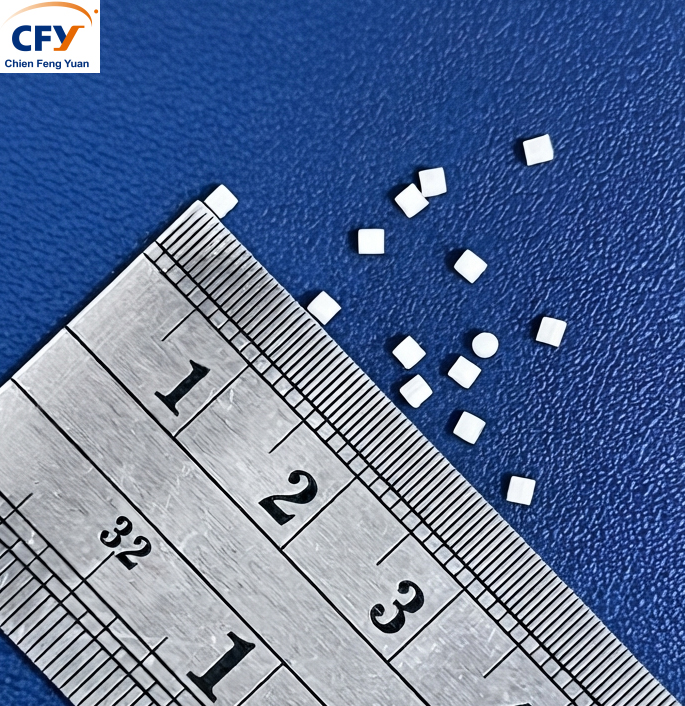
How Does Precision Mold Design Overcome Trapped Air, Flash, and Other Common Defects? (Q&A)
Q1: How does CFY solve "trapped air" (air trapping) and sink marks in multi-cavity micro molds?
A: Multi-cavity designs are often utilized in micro molding to enhance production efficiency, but they significantly complicate venting. As high-speed molten plastic converges inside tiny cavities, air can become trapped deep within the mold, causing "air trapping" that leads to sink marks, internal voids, or burns. CFY leverages extensive mold design expertise and advanced flow analysis to incorporate strategic venting designs along the parting line (PL surface), allowing high-pressure trapped gases to escape smoothly and effectively eliminating sink marks and voids from the root cause.
Q2: How does CFY prevent flash and burrs in extremely tight-tolerance micro components?
A: Micro molded products demand ultra-tight tolerances, requiring mold machining accuracy down to the micron level. If the parting line fit is insufficient, high injection pressures will easily force plastic into the gaps, creating flash. CFY utilizes high-precision CNC machining, rigorous steel selection, and optimized process parameters to ensure molds resist deformation under extreme pressure—eliminating flash and ensuring clean edges and seamless assembly for every micro component.
Q3: How are quality inspection and measurement challenges for micron-level dimensions overcome?
A: When product dimensions shrink down to the millimeter or even micrometer scale, traditional calipers and standard measuring tools are no longer effective. CFY is equipped with advanced non-contact measuring systems in-house, including high-precision image dimension measurement systems (such as the Keyence LM-1100), enabling rapid and precise micro-dimensional analysis and tolerance verification. Simultaneously, we utilize optical image measuring instruments to comprehensively inspect micro-structures, surface profiles, and potential micro-voids or defects. This provides international buyers with rigorous data support and significantly enhances trust in our quality control.


