1. Why Material Selection Is Actually a Failure-Prevention Decision
In injection molding, most product failures are not caused by design complexity, they are caused by mismatched material selection.
Typical real-world failure cases:
- A handheld outdoor device using ABS → Cracked after 3 months due to UV exposure
- A gear system using ABS instead of POM → Worn out within weeks due to high friction
- A thin transparent cover using PMMA instead of PC → Shattered under impact drop test
- An enclosure using Nylon without moisture control → Warped after humidity absorption
Material selection is not about “choosing plastic.” It is about matching material physics to product environment.
2. The 5 Engineering Parameters That Actually Decide Material Choice
Instead of starting with “which plastic is best,” engineers should evaluate these 5 parameters first:
2.1 Mechanical Strength (Tensile & Impact)
Typical ranges:
- ABS: ~35–50 MPa tensile strength
- PC: ~55–75 MPa tensile strength
- Nylon (PA6): ~60–80 MPa
- POM: ~60–70 MPa
But tensile strength alone is misleading.
Impact resistance matters more in real products:
- PC impact strength: Extremely high (Used in bullet-resistant applications)
- PMMA: Brittle, cracks under drop impact
- ABS: Moderate, good balance
Example: A drone body using PMMA instead of PC may pass static strength tests but fail drop tests immediately.
2.2 Heat Resistance (HDT – Heat Deflection Temperature)
Typical HDT values:
- ABS: ~85–100°C
- PC: ~120–135°C
- Nylon: ~140–180°C (Varies with grade)
- POM: ~100–120°C
Real failure case: A car interior component made from ABS near dashboard → Deformation under summer sunlight (>90°C surface temperature)
Correct choice: PC/ABS blend or heat-stabilized PC
2.3 Moisture Absorption (Critical but Ignored)
This is one of the most overlooked factors.
- ABS: Very low absorption (~0.2%)
- PC: Moderate (~0.3%)
- Nylon: High (~1.5–3% depending on grade)
- POM: Very low (~0.2%)
Engineering consequence: Nylon absorbs water → Expands → Dimensional change
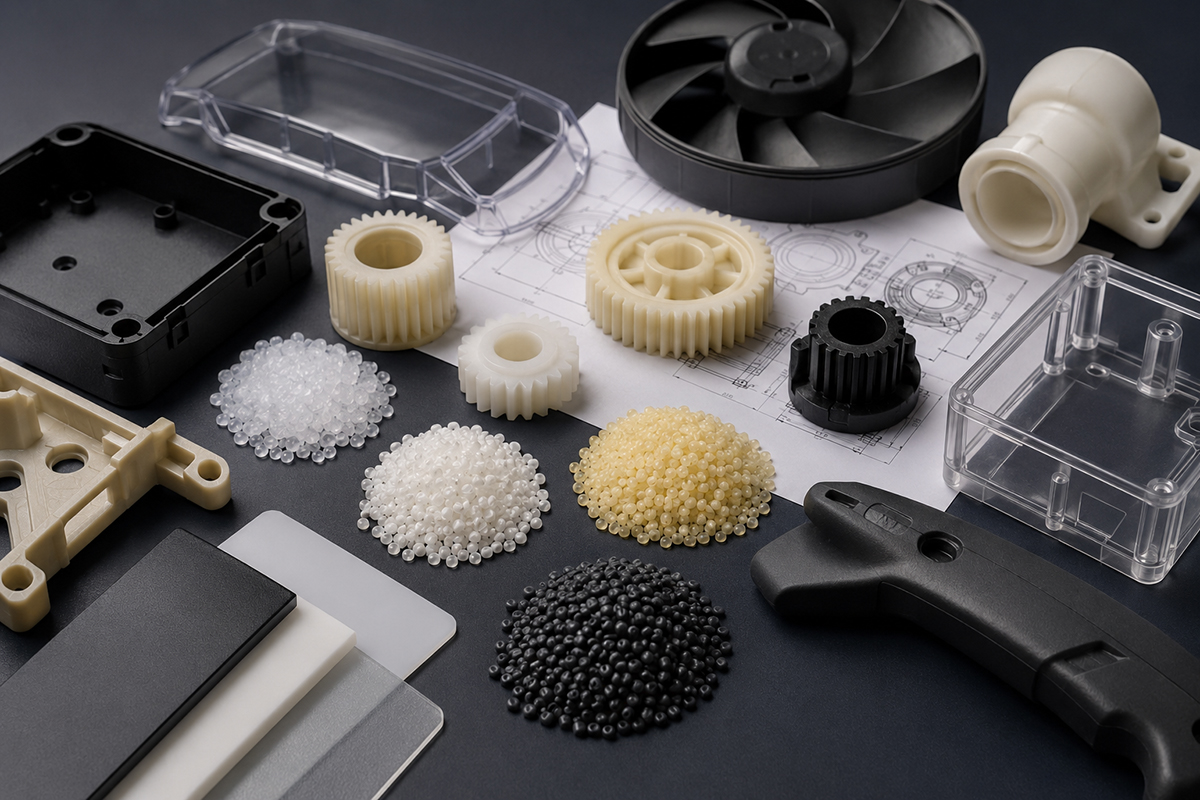
Example: Precision gear made from Nylon:
- Dry condition diameter: 20.00 mm
- Humid environment: Expands ~0.2–0.5%
→ Leads to jamming in assemblies
That is why precision gears often use POM instead of Nylon
2.4 Wear & Friction Behavior (Tribology)
Coefficient of friction (Typical):
- POM: Very low (~0.2) → Self-lubricating
- Nylon: Moderate (~0.3–0.4)
- ABS: Higher (~0.4–0.6)
Example: Sliding mechanism in printer:
- ABS → Noisy, wears quickly
- POM → Smooth, long life, no lubrication needed
This is why POM dominates precision mechanical parts
2.5 Environmental Resistance (UV + Chemicals)
- ABS → Weak UV resistance (Turns yellow, brittle outdoors)
- PC → Moderate, needs UV coating for outdoor use
- PP → Excellent chemical resistance
- Nylon → Weak against acids, absorbs moisture
Real case: Outdoor sensor housing:
- ABS failed due to UV degradation in 6–12 months
- Replaced with UV-stabilized PC → 3+ Years stable performance
3. Material Selection by Real Engineering Use Cases
Case 1: Outdoor Electronic Enclosure
Requirements:
- UV resistance
- Impact resistance (Drop test)
- Temperature stability
Best choice:
- PC or PC/ABS blend
- ABS only acceptable for indoor use
Case 2: Precision Gear System
Requirements:
- Low friction
- Dimensional stability
- Long wear life
Best choice:
- POM (Acetal)
Why not Nylon?
- Moisture absorption → Dimensional change → Gear misalignment
Case 3: Transparent Protective Cover
Requirements:
- High clarity
- Impact resistance
Options:
| Material | Clarity | Impact Resistance |
| PMMA | Excellent | Poor |
| PC | Very good | Excellent |
Industrial choice: PC almost always wins
Example:
- Safety visor → PC
- Display lens → PC or coated PC
- Decorative cover → PMMA only if no impact risk
Case 4: Low-Cost Consumer Product Housing
Requirements:
- Low cost
- Good appearance
- Moderate strength
Best choice: ABS
Why:
- Easy to mold
- Good surface finish
- Lowest cost among engineering plastics
4. The Practical Engineering Selection Rule (Used in Industry)
Instead of guessing material, engineers typically use this decision flow:
Step 1: Is it structural or cosmetic?
- Cosmetic → ABS / PC / PMMA
- Structural → Nylon / POM / reinforced materials
Step 2: Is it outdoors or exposed to UV?
- Yes → PC, ASA, UV-stabilized blends
- No → ABS or cheaper alternatives
Step 3: Is precision or movement involved?
- Yes → POM preferred
- No → ABS/PC acceptable
Step 4: Is temperature >100°C?
- Yes → Nylon / high-temp PC
- No → ABS/PC/PP possible
5. The Most Common Engineering Mistakes
Mistake 1: Choosing ABS for outdoor use
→ Leads to cracking + yellowing
Mistake 2: Using Nylon for precision parts without humidity control
→ Leads to dimensional instability
Mistake 3: Choosing PMMA for impact parts
→ Brittle failure under load
Mistake 4: Overusing high-performance plastics
→ Unnecessary cost increase (e.g., using PC when ABS is sufficient)
6. Final Engineering Insight
There is no “best plastic.”
There is only: “the most suitable material for a specific environment and load condition.”
A good material selection process balances:
- Mechanical performance
- Environmental resistance
- Manufacturing cost
- Long-term stability
Conclusion
Material selection should always be treated as an engineering decision, not a purchasing decision.
By analyzing real parameters such as impact strength, heat resistance, moisture absorption, friction behavior, and environmental exposure, engineers can significantly reduce product failure rates and improve long-term reliability.
For injection molding projects, early-stage material selection is often the difference between a stable mass production product and repeated redesign cycles.