Injection molding is one of the most cost-effective manufacturing methods for largescale production. However, many companies are surprised by how quickly costs can escalate, especially during the early stages of product development.
If your injection molding quote seems higher than expected, the issue is often not the process itself, but the design, material choice, or production strategy.
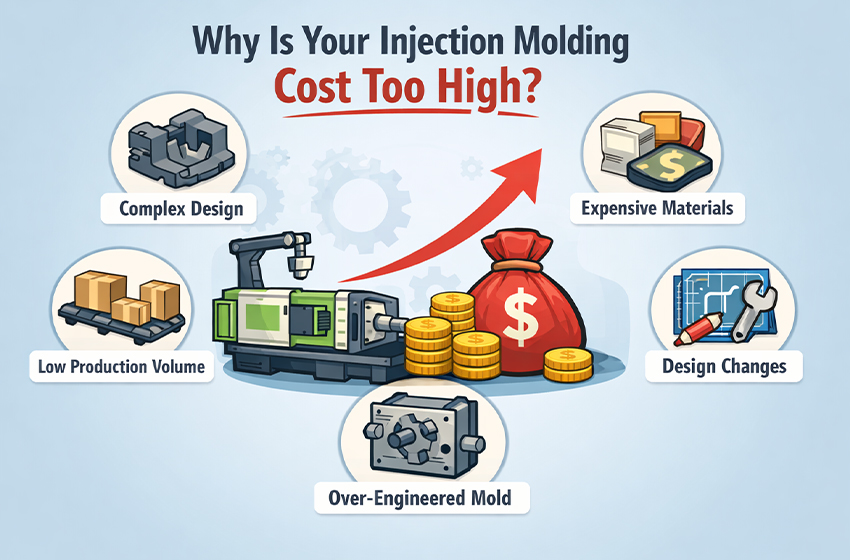
In this article, we’ll break down the top 5 reasons your injection molding cost is too high—and how to fix each one.
1. Poor Part Design (Unnecessary Complexity)
The Problem
Complex geometries, undercuts, sharp corners, and inconsistent wall thickness increase mold complexity and production difficulty.
Why It Increases Cost
- Deep or thin ribs that may cause sink marks or warping
- Excessive sharp corners that create stress concentration and difficult mold flow
- Unnecessary undercuts or angled holes that could be simplified
- Non-functional surface textures or intricate details that complicate mold machining
- Inconsistent wall thickness that increases cooling time and risk of defects
How to Fix It
- Simplify geometry wherever possible
- Maintain uniform wall thickness
- Replace sharp corners with fillets or gentle curves
- Avoid unnecessary undercuts or overly complex holes
- Limit excessive surface textures to functional or aesthetic needs
Tip: Design for manufacturability (DFM) early to prevent costly revisions and reduce tooling complexity.
2. Incorrect Material Selection
The Problem
Choosing high-performance or specialty plastics when they’re not required.
Why It Increases Cost
- Higher raw material cost
- More difficult processing
- Increased wear on molds
How to Fix It
- Select materials based on actual performance needs
- Consider cost-effective alternatives
- Consult with your manufacturer early
3. Low Production Volume
The Problem
Injection molding has a high upfront mold cost, which is only economical at higher volumes.
Why It Increases Cost
- Mold cost is distributed over fewer units
- Higher cost per part
How to Fix It
- Use CNC machining or 3D printing for prototyping
- Transition to injection molding only when volume increases
4. Over-Engineering the Mold
The Problem
Designing molds with excessive precision or unnecessary features.
Why It Increases Cost
- Longer mold fabrication time
- Higher tooling cost
- Increased maintenance
How to Fix It
- Match mold precision to product requirements
- Avoid over-specifying tolerances
5. Frequent Design Changes
The Problem
Late-stage design changes after mold fabrication has started.
Why It Increases Cost
- Mold rework or redesign
- Production delays
- Additional engineering costs
How to Fix It
- Finalize design before tooling
- Conduct prototype testing first
- Work closely with your manufacturer during design
Conclusion
High injection molding costs are often avoidable with the right approach. By optimizing your design, selecting appropriate materials, and planning production strategically, you can significantly reduce costs without compromising quality.
Need help reducing your injection molding costs?
Our engineering team can review your design and provide cost-effective solutions tailored to your production goals. Contact us today to get started.