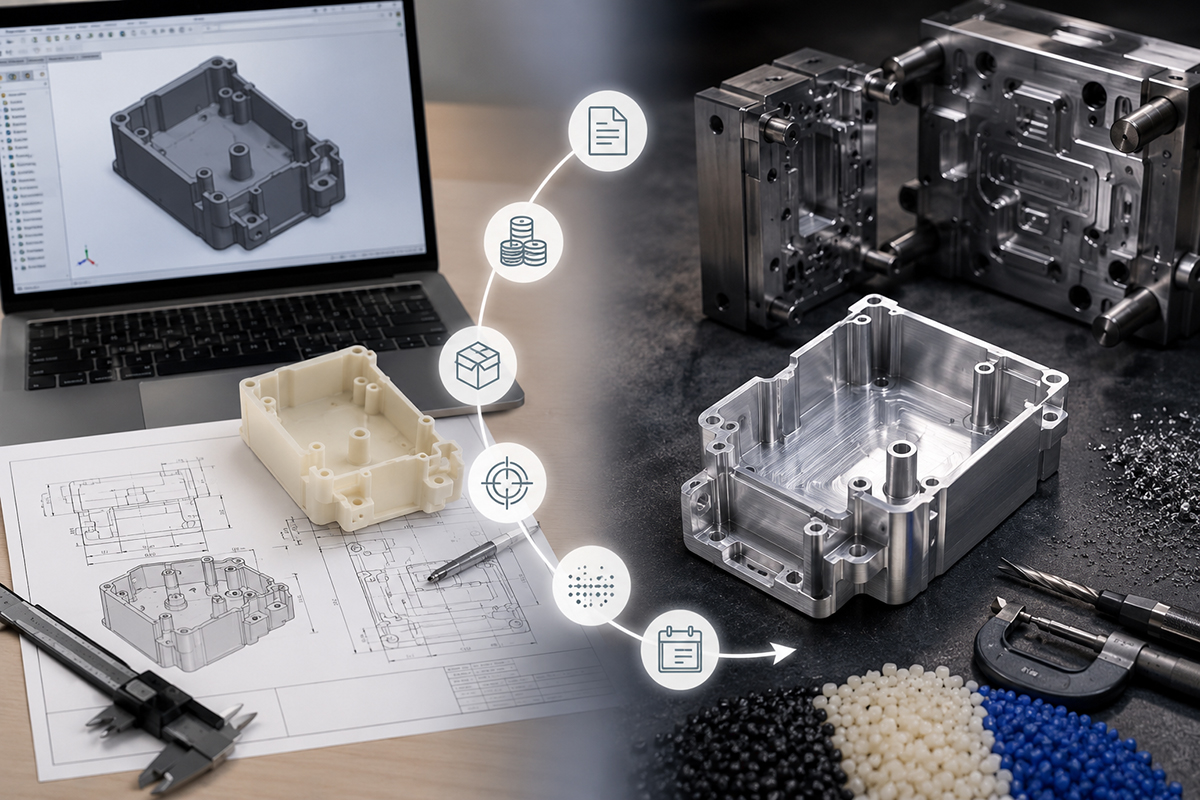
Sending an RFQ sounds simple, you describe your part and wait for a price. But an incomplete RFQ is one of the most common reasons projects get delayed before manufacturing has even started. When key information is missing, manufacturers either make assumptions (leading to inaccurate quotes) or come back with questions, adding days or weeks of back-and-forth you didn't plan for.
Here is what to include to get a fast, accurate quote — for both injection molding and CNC machining projects.
1. A Complete Drawing or 3D File
A 3D STP or X_T file plus a 2D drawing with critical dimensions called out gives the manufacturer everything needed to assess your part. For injection molding, this allows the mold engineer to review draft angles, parting lines, and gate placement before quoting. For CNC, it covers toolpaths, fixturing, and inspection requirements.
Common mistake: Sending only a sketch or an unfinished model. Quotes based on incomplete geometry are rarely accurate and almost always need revision.
2. Material Specification
For injection molding, name the resin if you know it — ABS, PC, PP, nylon, POM. If you have requirements around heat resistance, chemical exposure, or compliance standards, mention those too. For CNC, specify the alloy and grade, aluminum 6061 and 7075 machine differently; stainless 303 and 316 are not interchangeable.
If you are unsure, describe the functional requirement and let your manufacturer advise.
3. Quantity — Now and Long Term
For injection molding, the mold cost is spread across total lifetime production, so your projected annual volume directly affects what type of tooling is recommended. For CNC, quantity determines setup and batch efficiency. Always provide both your immediate order quantity and your expected volume over the next 12 months.
4. Critical Tolerances
Mark your critical dimensions on the drawing and specify tolerances only where they matter functionally, at assembly interfaces, sealing surfaces, or snap-fit features. Applying tight tolerances uniformly across a part increases cost without adding value. Leaving tolerances entirely blank forces the manufacturer to guess.
5. Surface Finish Requirements
For injection molded parts, surface finish is a mold decision, it cannot be changed after the tool is built. Specify an SPI grade if you know it, or describe the requirement in plain language: high-gloss consumer finish, light texture, or purely functional with no appearance requirement.
For CNC parts, specify Ra value or callout: as-machined, bead blasted, anodized, powder coated.
6. Timeline and Context
Give a target delivery date and — briefly — why it matters. Is this a prototype for design validation, or a production run tied to a launch? Is the design locked or still evolving? This context allows the manufacturer to flag risks early and recommend the right approach rather than just the fastest one.
Quick Checklist
- 2D drawing + 3D file (STP or X_T preferred)
- Material — resin type or metal alloy and grade
- Quantity — immediate order and annual volume forecast
- Critical tolerances — marked on drawing where functionally required
- Surface finish — SPI grade, Ra value, or plain description
- Timeline — target date and project context
A well-prepared RFQ typically takes a few hours to put together and can save weeks of delay. At CFY, our engineering team reviews every inquiry and provides DFM feedback before production begins — whether your design is finalized or still in development.
Contact us at [email protected] or visit www.cfy-tech.com to submit your project.