

With the rapid advancement of optical technologies, the demand for high-precision and high-transparency optical components has significantly increased. Plastic Injection Molding, as a highly efficient and cost-effective manufacturing technique, has been widely applied in the production of various optical components. Compared to traditional glass materials, glass tends to increase the overall weight due to its high density, and it also involves higher processing costs and greater difficulty.
Moreover, its brittleness and susceptibility to breakage make it less suitable for large-scale or customized production. In contrast, plastic materials offer advantages such as low weight, high processing flexibility, excellent moldability, and lower costs. With the use of precision molds, plastics can be formed into complex structures with excellent optical performance.
Plastic Injection Molding is a process in which thermoplastic materials are heated to a molten state and injected into metal molds, where they are cooled and solidified to form various plastic parts. This technique offers benefits such as fast production cycles, high dimensional accuracy and stability, and excellent repeatability. As a result, it is widely used in industries including automotive, electronics, medical, consumer products, and optical components.
LED Lamp Cover Applications
LED lamp covers are a representative example of plastic injection molding in optical applications. Common materials such as polycarbonate (PC) and polymethyl methacrylate (PMMA) offer excellent light transmittance and heat resistance. Depending on the design requirements, lamp covers can be manufactured in diffusing, collimating, or light-guiding structures to improve light uniformity and reduce glare. By combining precision molds with a stable injection molding process, fine surface textures and specific optical effects can be achieved. These lamp covers are widely used in general lighting, automotive headlights, and electronic displays.
LED Collimating Lens Applications
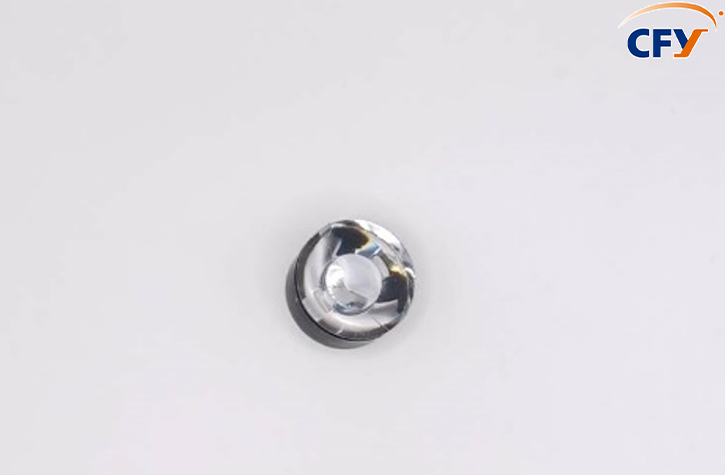
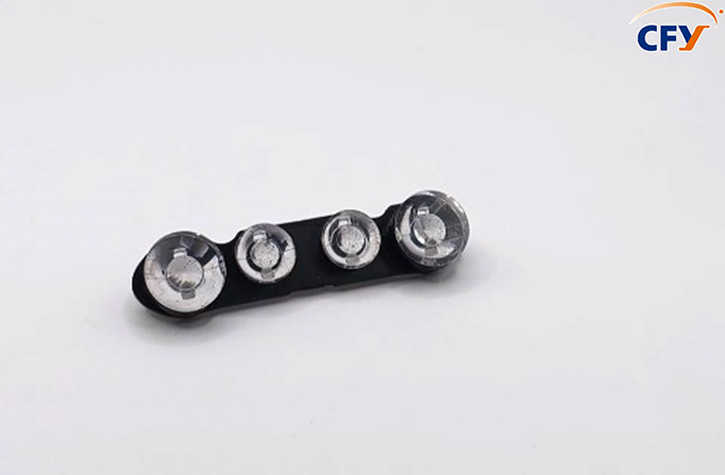
LED collimating lenses are another key application of optical-grade plastic injection molding. Their primary function is to precisely control the beam angle, concentrate light energy, and minimize light loss. Based on optical design needs, the lenses can be formed into concave or convex structures. Materials commonly used include optical-grade PC or PMMA to ensure high transmittance, dimensional stability, and surface accuracy. These lenses are extensively applied in projectors, automotive headlights, stage lighting, and display backlight modules, where high optical performance is required.
LED Holder Applications
In addition, the LED holder (also known as LED housing) is another common plastic injection molded component. Its primary functions are to protect the LED chip and optical modules while providing reliable structural support and an installation interface. Plastic materials offer excellent electrical insulation, effectively preventing circuit shorting and enhancing product safety and stability. Through advanced injection molding techniques and mold design, LED holders can be mass-produced efficiently, reducing manufacturing costs. Complex features such as clips, screw posts, ventilation holes, and waterproof structures can also be integrated to improve assembly efficiency and overall functionality.
Chien Feng Yuan Technology has over 20 years of experience in plastic injection molding and mold development. We can design and manufacture molds based on customer-provided drawings, supply trial samples for validation, and handle subsequent mass production. We provide fully integrated services—from mold fabrication to mass production—and have successfully exported to more than 40 countries worldwide. Leveraging our extensive expertise and complete manufacturing system, we help customers significantly shorten product development and time-to-market while maintaining effective cost control.


